
Buying & Selling
Level-2 camera/video inspections for the purpose of buying or selling a home is not a provided service. The below information is intended as a courtesy for both buyers and sellers.
Notice to realtors: I am not available for hire, as I only provide service to the private homeowner.
Disclosing All Findings

Ex: Exposed Heating System Lining Above Fireplace
It's common practice for licensed chimney professionals to cite chapter and paragraph for building code deficiencies and violations, regardless if the home and property are for sale.
SELLERS: Observable building code violations will be documented and disclosed. This is to transfer liability to the home owner if the appliance(s) are continually used post-servicing and inspection. Asking me to omit such findings or supplementary service and repair recommendations is unethical. Asking me to remit a new invoice stating only chimney sweeping was performed will not be humored (but thoroughly laughed at).
If I am hired and you're selling your house, I will definitely NOT humor the request of omitting defects and violations. The sale of your house will not be more easily facilitated at the expense of my company's liability. I take these requests as a great insult as it shows a complete lack of value in my work and my good standing. If you feel I'm not the right fit for your chimney service needs based on the above-mentioned, you're not the right fit for me as a customer.

Adoption of...
N.J.A.C.5:23 (1996)
New Jersey adopted the ICC's IRC as its, state-wide building code standard in 1996. Grandfathering is permitted for no greater than a 6 month period after the release of a new publication. The latest publication of "Chapter 10: Chimneys & Fireplaces" is January 2024. Code violations are cited/documented on invoices.
R1003: Chimney Construction

R1003.1: General/Exterior

Interpreted under R1003.1, painting a masonry chimney's exterior surface is one of the worst things a home owner can have done. All masonry is porous, and will absorb water and precipitation. This is especially important when located in the northeast, as there's no short supply of rainy springs, summer humidity, autumn hurricanes, and snowy winters. Paint acts as a sealant, and painted masonry will lose its ability to breathe when warm-weather temperatures would normally allow for the evaporation of internal moisture.
Additionally, the chemical process of combustion yields water and condensation within the exhaust mixture (especially for gas applications). Some fuel types have either a high or low condensation content; gas applications have the highest. When an adequate volume of trapped, internal moisture isn't able to breathe and evaporate, the chimney structure will undergo freeze-thaw damage over the winter into the spring. This may occur over just one year, but most times will take several years.
Aside from the unsightly polka-dot aesthetic, this will also compromise the chimney's structural integrity, and most times the corrective repair is a roofline-up or ground-up (and costly) rebuild. It is always recommended to have a painted chimney's surface sandblasted to remove paint.

Clearances
R1001.11
This paragraph outlines combustible trim and materials having to remain a minimum of 12 inches above the fireplace opening. While the TV satisfies the requirement, electronics are sensitive to heat and smoke, and may still become damaged when suspended above or in front of a fireplace.
R1003.9: Minimum Chimney Height
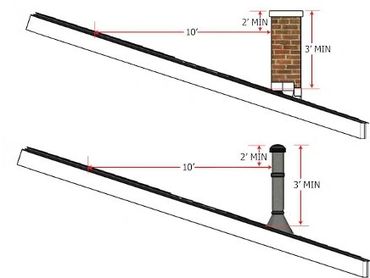
R1003.12: Flue Lining

The most frequently occurring reason for new chimney liner installation is R1003.12, found in Chapter 10 "Chimneys & Fireplaces" under the IRC. Conventional cement (sand-mortar mix) joints are not water-insoluble, and will become loose, sandy, and gritty over the years, and will eventually fall out. This will lead to gaps and openings between clay flue tiles at every two-foot iteration. If the chimney structure undergoes thermal shock (chimney fire), conventional cement joints are "blown out" due to not being made from high-heat rated refractory mortar. Soot and flammable creosote will be able to circumvent flue tiles, and become trapped in the air spaces between the chimney's outer shell and interior flue liner, rendering basic chimney sweeping all but useless for preventing future chimney fires.
Regardless of condition, when converting fuel types (wood-to-gas for fireplaces and oil-to-gas for home-heating systems), liner installation will be required. This includes appliance replacement for similar fuels (changing out a hot water tank). Municipal building departments now issue a "chimney verification certificate" in plumbing permits, to which your plumber or HVAC company will have to submit once a chimney inspection has been performed. If chimney "relining" is required masonry chimney structures for homes built prior to 1996), a separate permit from your town is required in conjunction with fuel conversions and appliance replacements. Chimney "relining" is the standard repair solution when the above-mentioned building code is in violation. It is also the most commonly occurring chimney repair, being able to correct such issues as flue decay/deterioration, shifted/misaligned flue tiles due to settling, and absences of an original lining due to incorrect or predated home construction.
Spray-On Liner Scams


Spray-on liners are a scam, "installed" by scammer companies. Beware of companies offering products like "Heat-Shield." Most flue linings are already considered undersized in relation to their fireplace size. Applying a spray-on mortar will further constrict the chimney's interior, and can lead to down-draft, and can cause smoke re-entry into your living room. Applications are applied too thin, and flake off with time and usage; entire sections are scraped off during regular chimney sweeping maintenance, too. Keep in mind, chimney liner installations and repairs require permits and a municipal inspection - there are no exemptions. Companies offering same-day chimney liner repair or companies stating permits aren't required, are more than likely uninsured and unlicensed.

Chimney "relining," where stainless steel liner sleeves are lowered in, is the correct repair methodology. Most times, the original clay flue liner is broken and extracted, allowing for the correct sizing and diameter to fit. More than half the time these are installed, an application of insulation is required. Liner sleeves can either be wrapped in an insulation blanket, or a vermiculite-based insulation is mixed with water and poured around the empty spaces between the new liner and chimney's masonry.
This process is much more involved, laborious, and costly, so it's understandable homeowners would opt for the cheaper spray-on liner applications. Relining projects take take one day or up to over one week, and can cost thousands of dollars, but it's a buy-once cry-once repair expense. Flexing your rights as a homeowner are crucial; it's your right to request ANY home service company to furnish proof of their licensure and insurance coverage. A company's license number can be cross-referenced with the NJ Division of Consumer Affairs' website, which will inform homeowners of that company's status.
Unlined Masonry Fireplace with Insert-Stove
Factory-Prefab Fireplace with Free-Standing Stove
Unlined Masonry Fireplace with Insert-Stove

Both NFPA-211 regulation and IRC R1003.12 building code require this application to have a stainless, insulated chimney lining system installed throughout the entirety of the chimney height.
Factory-Prefab Fireplace with Insert-Stove
Factory-Prefab Fireplace with Free-Standing Stove
Unlined Masonry Fireplace with Insert-Stove
Not permitted under NFPA-211 regulation and IRC R1004.1 and R1005.1, as UL-1777 compliance for the lining system isn't achieved and UL-127 is violated according to both the fireplace and liner manufacturers.
Factory-Prefab Fireplace with Free-Standing Stove
Factory-Prefab Fireplace with Free-Standing Stove
Factory-Prefab Fireplace with Free-Standing Stove
Not permitted under NFPA-211 regulation and IRC R1004.1 and R1005.1, as UL-1777 compliance for the lining system isn't achieved and UL-127 is violated according to both the fireplace and liner manufacturers.
Prefab Fireplace with Pellet Stove or Insert
Prefab Fireplace with Pellet Stove or Insert
Factory-Prefab Fireplace with Free-Standing Stove
Not permitted under NFPA-211 regulation and IRC R1004.1 and R1005.1, as UL-1777 compliance for the lining system isn't achieved and UL-127 is violated according to both the fireplace and liner manufacturers.
Converging Flues
Prefab Fireplace with Pellet Stove or Insert
Converging Flues
Every appliance is required to have its own flue liner. Converging flues ceased pre-Civil War in the 1840s and 1850s. Converging flues create a syphoning effect, where exhaust will be pulled back down into a lower level of the house.
Mixed Fuel Types
Prefab Fireplace with Pellet Stove or Insert
Converging Flues
Oil home-heating systems sharing a flue with a natural gas or propane water tank is still permissible in most areas, but solid-fuel (wood, coal, pellet) appliances cannot share a flue with oil or gas home-heating appliances, under NFPA-211, NFPA-31, and NFPA-54.